
At dusk, the canopy walkway sways just enough to notice with every step — a narrow aluminium bridge strung 26 metres above the forest floor, swaying gently between platforms lashed to the trunks of dipterocarps that were already centuries old when this whole valley was still just a name on a logging company’s map. Our guide stops at the highest platform to watch the light go copper over the canopy. “Almost none of this was supposed to still be standing,” he says.
He isn’t exaggerating. Danum Valley’s 438 square kilometres sat, until the early 1980s, inside a single vast logging concession of nearly a million hectares granted to Yayasan Sabah, the state’s semi-governmental forestry foundation. What saved it wasn’t a park designation or a protest — it was a 1976 scientific survey, sponsored by the Sabah Natural Parks Board and funded by the World Wildlife Fund, that came back describing a forest too biologically important to log. Yayasan Sabah quietly carved the valley out of its own concession in 1981, and it took until May 1995 for the area to be formally gazetted as a Class I Protection Forest Reserve under Sabah law — a fourteen-year gap in which the valley’s protection rested on little more than an internal decision that could, in theory, have been reversed.
From research camp to five-star address
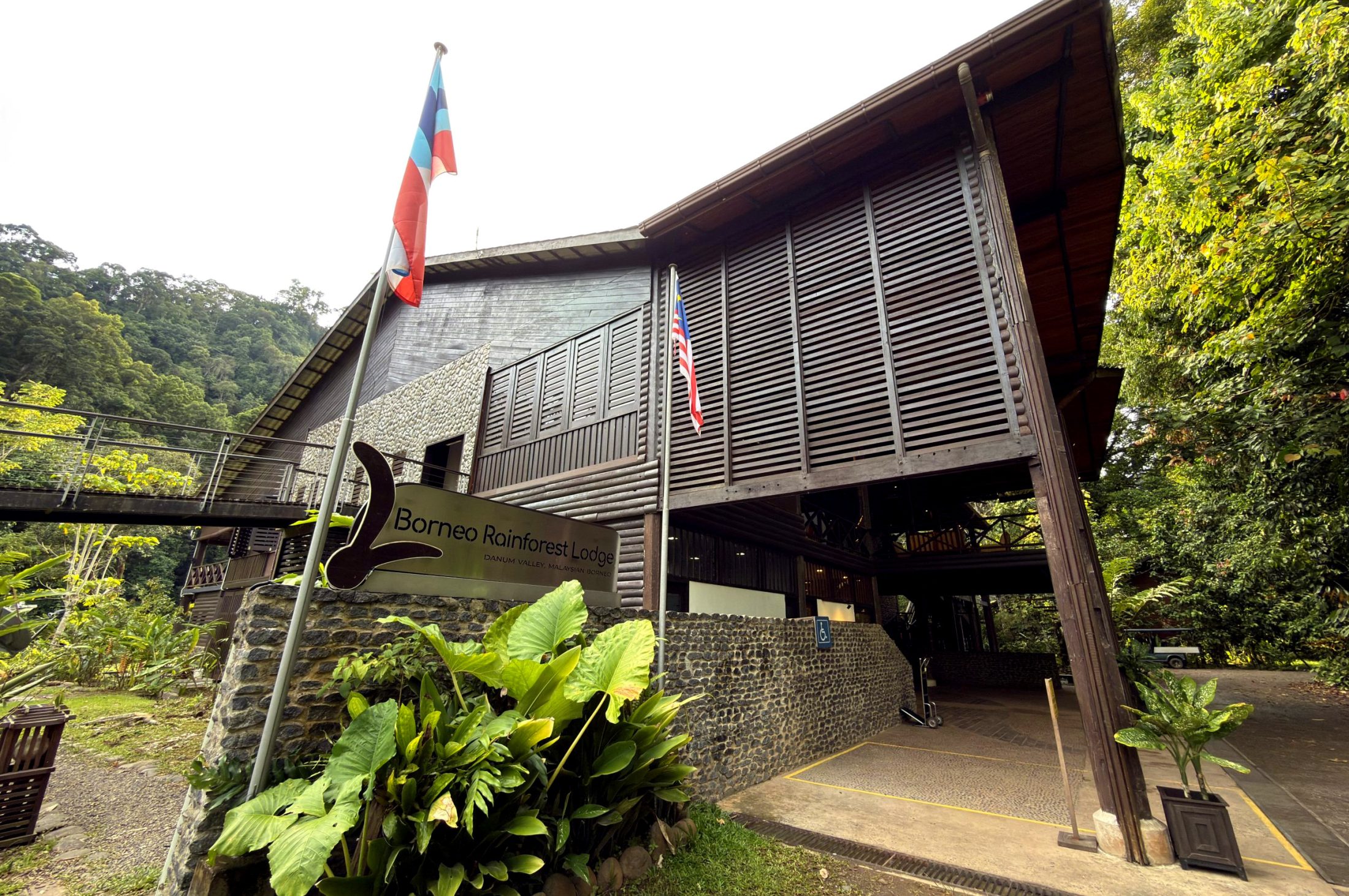
Long before there was a lodge, there was only the Danum Valley Field Centre — a research station built deep in the reserve for scientists studying a forest with no prior human settlement at all, propagating dipterocarp seedlings by the hundred thousand for restoration work elsewhere in Sabah. Tourism arrived almost as an afterthought to the research. Borneo Rainforest Lodge opened in 1994, built by a small team that trained local staff on wildlife-guiding programmes borrowed from as far away as Nepal, and its canopy walkway — then one of the longest of its kind anywhere — opened the same year, threading roughly 300 metres through the upper storey.
Three decades on, it remains the only accommodation permitted inside the conservation area itself, a distinction every other Danum-area operator has to work around from outside the boundary. Today it runs as an exclusive five-star, all-inclusive lodge: around thirty timber chalets and villas raised on stilts along the Danum River, guided walks and night drives built into every stay, a spa offering a “jungle trekking” treatment for muscles that have earned it, and a guest book that has, over the years, included British royalty. None of which changes what’s outside the window — still 438 square kilometres of forest with no roads, no villages, and no history of ever having had either.
“People come for the five stars,” our guide says, as we start back along the walkway in the last of the light, “and by the second night they’ve stopped asking about the thread count and started asking when the gibbons start calling. That’s the part of this place I don’t think will ever get old.”