
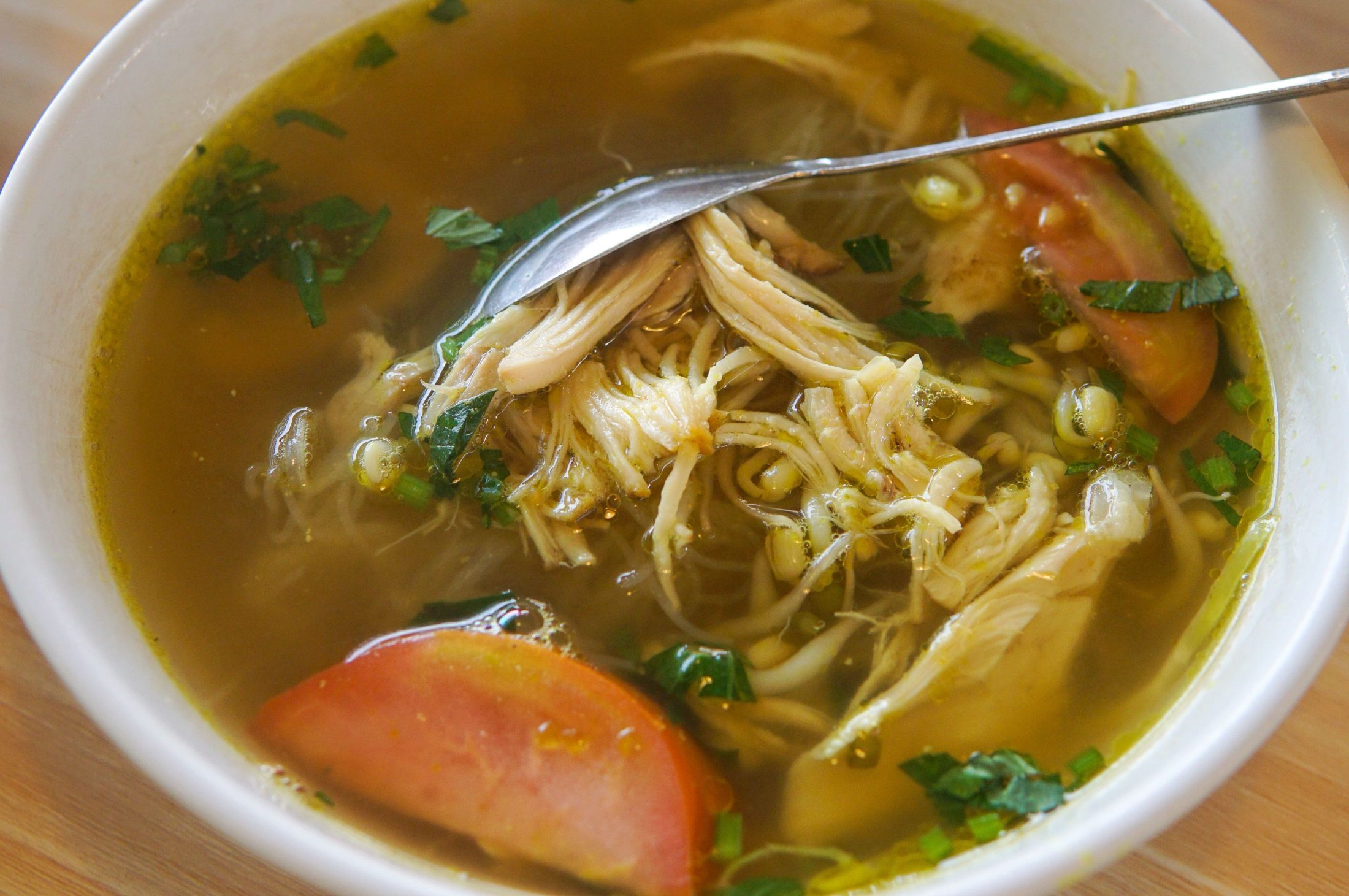
Ask ten Indonesians what soto is, and you’ll get ten different, mildly defensive answers — and most of them will be right.
Soto is, broadly, a turmeric- or clear-broth soup built around chicken, beef or offal, served with rice or rice noodles and whatever garnish a given region has decided is non-negotiable. Beyond that broad description, the dish fractures almost county by county. Soto Lamongan, from East Java, is thickened with koya — a pungent, savoury powder of ground fried garlic and crackers — sprinkled on top like a seasoning of its own. Soto Betawi, from Jakarta, swaps the clear broth for one enriched with coconut milk and sometimes evaporated milk, making it closer to a curry than a soup. Coto Makassar, from South Sulawesi, uses ground peanuts and up to forty spices in its broth and is traditionally eaten with ketupat, compressed rice cakes, rather than plain rice.
A dish that resists a single recipe
“If you tried to standardise soto, you’d be fighting a losing battle against about six hundred years of local variation,” says Ibu Sri, who has run a soto stall in Surabaya’s Pasar Wonokromo for over twenty years and inherited the recipe, more or less unchanged, from her mother. “Every town thinks its version is the real one. They’re all correct, and none of them will admit that.”
Part of the reason soto splinters so dramatically is that it was never a single migration from a single source. Food historians trace its roots partly to Chinese soups brought by traders and partly to indigenous stewing traditions already present across the archipelago, the two influences meeting and re-meeting in different port towns over centuries, each producing its own local hybrid.
Reading a place through its bowl
Spend a few weeks moving between Javanese, Sulawesi and Sumatran towns, and the soto starts to function almost like a regional dialect — legible if you know what you’re looking at, and a fairly reliable shorthand for what a place values. Coastal towns lean toward the punchy, spice-heavy versions; inland, agricultural regions often favour something milder and starchier, built to be filling rather than showy.
Ibu Sri, for her part, has no interest in ranking the variations. “My soto is Surabaya’s soto,” she says, ladling broth over a mound of rice vermicelli without looking up. “Somebody in Makassar is having this same argument right now, about their own bowl. That’s fine. That’s the whole country, really — a lot of small, correct arguments.”


Leave a Reply