
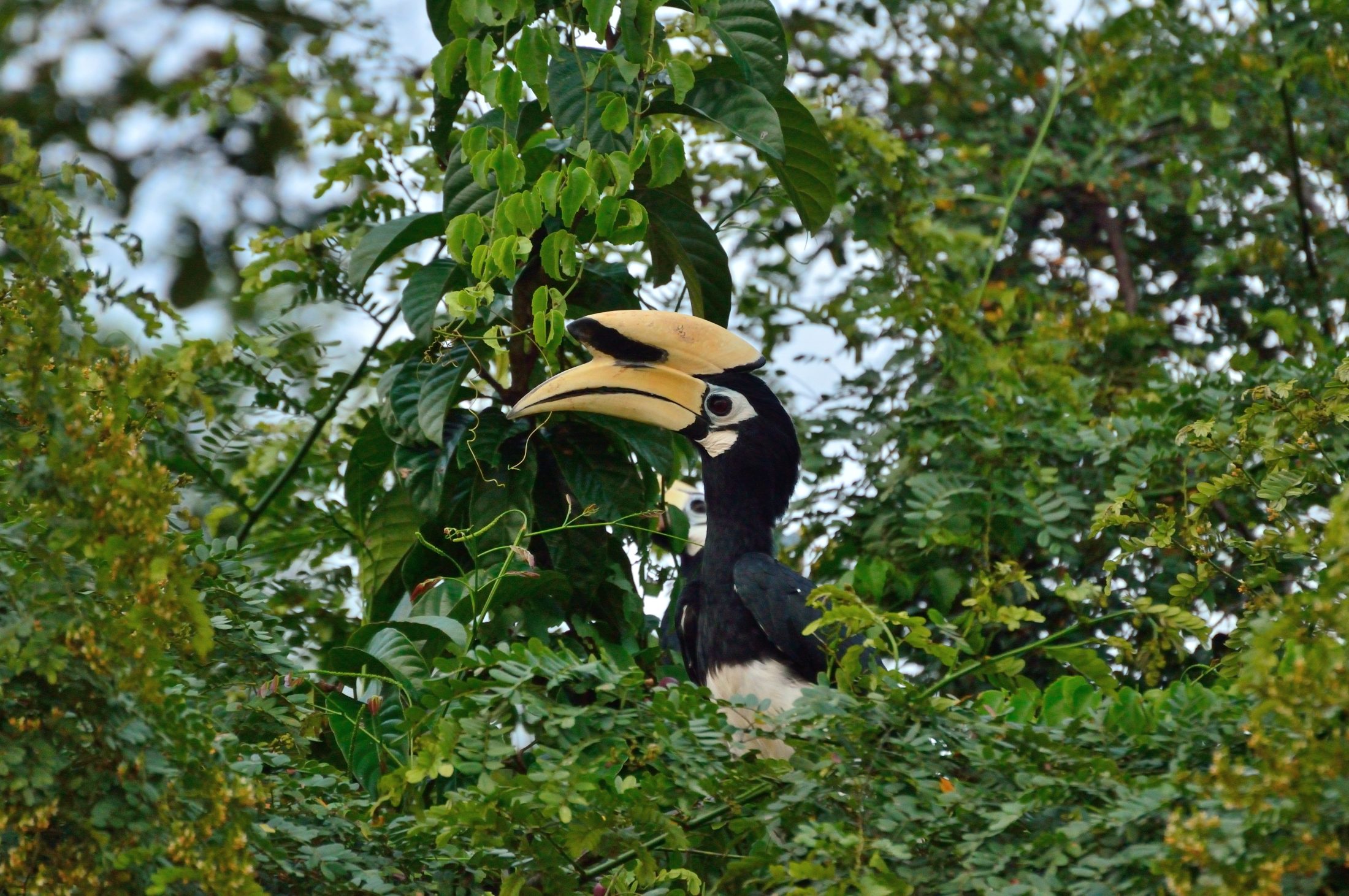
The forest at Danum Valley starts talking before it’s light. At 5:40am, ranger Jamil bin Suhaili is already crouched at the edge of the boardwalk, head tilted, listening for a sound most people never learn to separate from the general roar of the canopy: the low, hollow whoomp-whoomp-whoomp of a rhinoceros hornbill’s wingbeat.
“You hear them before you see them,” he says. “Always.”
Danum Valley, a 438-square-kilometre block of primary rainforest in the Malaysian state of Sabah, is one of the last substantial stretches of untouched lowland forest left in Borneo — and one of the few places on Earth where all eight of the island’s hornbill species can still be found within a single reserve. For Jamil, who has worked as a ranger here for eleven years, the birds are less a checklist than a kind of daily weather report: where the hornbills are feeding tells him where the fig trees are fruiting, which tells him, in turn, where everything else — the gibbons, the civets, the occasional shy clouded leopard — is likely to be.
A forest that keeps its own time
We move along the boardwalk in near-total silence, the kind that takes real effort to keep. Sound carries strangely under a closed canopy; a dropped water bottle a hundred metres away lands like a gunshot. Jamil stops every twenty paces or so, not to point anything out but simply to listen.
By 6:15am, the light has changed from black to a deep undersea blue, and the calls start layering on top of each other — gibbons first, then a pair of helmeted hornbills further off, their calls rising into the maniacal laughing cackle that gives the species its local nickname, “the forest’s clown.” Jamil doesn’t smile at this so much as nod, as if confirming something he already suspected.
“People come here wanting to see something,” he says, as we finally spot a rhinoceros hornbill gliding between two emergent trees, its casque catching the first real sunlight of the day. “But mostly, this place is about learning to hear it first.”
Why it still stands
Danum Valley owes its survival less to a single dramatic conservation victory than to a long accumulation of small, unglamorous decisions — a logging concession that was never renewed, a research station that gave the area scientific value early enough to matter, a state government that eventually decided intact forest was worth more standing than felled. None of it was inevitable.
Jamil, who grew up in a village two hours from the reserve’s edge, is matter-of-fact about what’s at stake. “My son has never seen a hornbill outside a cage or a photo,” he says. “I would like that to change before I stop working.”


Leave a Reply